Specs
| Function | Spec |
|---|---|
| Oscilloscope | |
| Channels | 2 (CH1 + CH2, BNC) |
| Bandwidth | 50 MHz |
| Sampling Rate | 250 MSa/s |
| Record Depth | 1 Kpts |
| Max Input Voltage | ±400V (with 10x probe) |
| Vertical Sensitivity | 10mV/div to 10V/div |
| Trigger Modes | Auto / Normal / Single |
| Math Functions | 8 (including FFT) |
| Extra Modes | XY mode, persistence, cursor measurement |
| Multimeter | |
| Resolution | 4.5 digits, 19999 counts |
| DC Voltage | 0 to 999.9V |
| AC Voltage | 0 to 750V |
| DC/AC Current | 0 to 9.999A |
| Resistance | 0 to 19.99 MΩ |
| Capacitance | 0 to 99.99 mF |
| Other | Continuity, diode, true RMS |
| Accuracy | 0.5% basic |
| Signal Generator | |
| Max Frequency | 50 kHz |
| Step Size | 1 Hz |
| Waveforms | 13 types |
| Max Output | 3V peak-to-peak (no load) |
| Output Impedance | ~50 Ω |
| General | |
| Display | 2.8″ IPS, 320×240 |
| Battery | 3000mAh Li-ion, ~6h standby |
| Charging | USB-C, 5V/1A |
| Dimensions | 170 x 90 x 35 mm |
| Price | ~$103 (standard) / ~$106 (Plus with 2 probes) |
Previously, on Debugging the Reality…
In the first part of this series, I wrote about the FNIRSI DPS-150 and how a USB-C PD powered bench supply killed the concept of the stationary workbench. If you haven’t read it, the short version is: a $70 programmable power supply running off a power bank means you can prototype anywhere. No wall socket required.
But power is only half the story. Once you have power, you need to see what’s happening. You need to measure voltage. You need to look at signals. And sometimes, you need to inject a signal to test a circuit’s response. That’s three instruments: a multimeter, an oscilloscope, and a function generator. Three boxes. Three sets of probes. Three power cables. Three reasons to stay chained to your bench.
Or, you could carry one device that does all three. Enter the FNIRSI 2C53T.
What We’re Dealing With
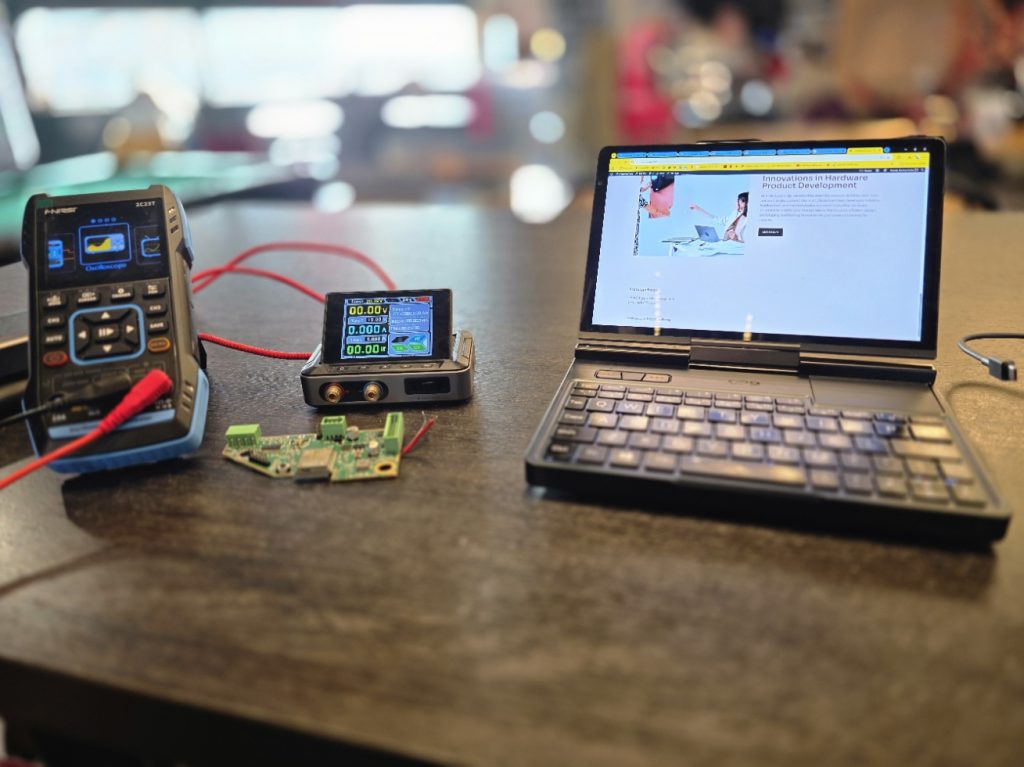
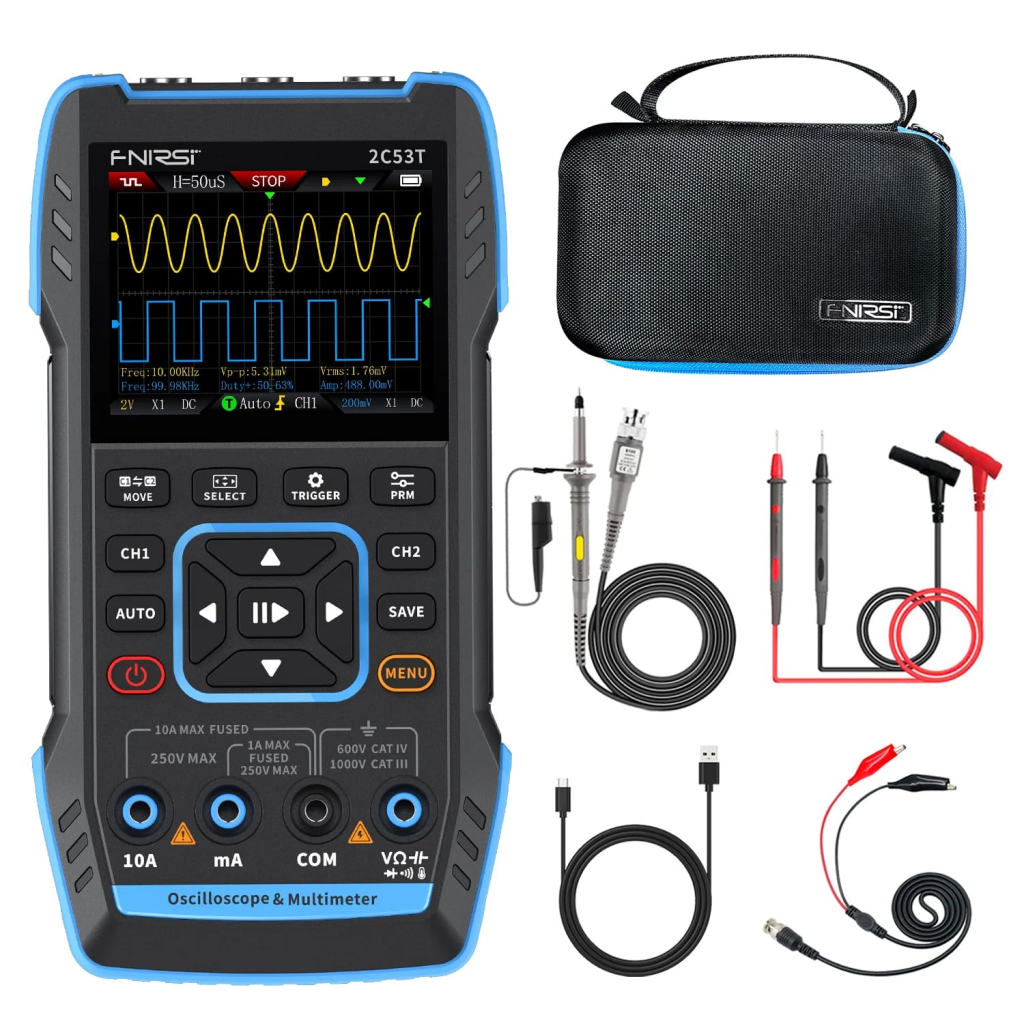
The 2C53T is a handheld 3-in-1 instrument that packs a dual-channel oscilloscope, a true RMS multimeter, and a DDS signal generator into a case measuring 17 x 9 x 3.5 cm. It weighs about as much as a large smartphone. It runs on a built-in 3000mAh lithium battery that gives you roughly 6 hours of use, and charges over USB-C. It costs around $103.
Let me put those specs in context. When I started working with embedded systems, a 50 MHz dual-channel oscilloscope alone was a piece of equipment that cost four figures and needed its own shelf. Now it’s a feature in a device that fits in a jacket pocket, next to a multimeter and a signal generator.
Whether that feature is good enough is a different question entirely. Let’s dig in.
The Oscilloscope: The Star of the Show
Let’s start with what actually matters here, because the oscilloscope is the reason you’d buy the 2C53T over a standalone multimeter.
The 2C53T is an upgraded version of the older 2C23T, and the scope section is where the upgrade is most dramatic. We went from 10 MHz bandwidth and 50 MSa/s sampling to 50 MHz and 250 MSa/s. That’s a 5x jump on both axes. For a handheld device under $110, that’s exceptional.
50 MHz bandwidth means you can meaningfully observe signals on SPI buses, I2C at higher speeds, UART, PWM outputs from microcontrollers, switching regulator behavior, and most of what you’d encounter in embedded and IoT prototyping. Dual channels mean you can watch a signal and its reference simultaneously, or compare input to output of a filter stage. The FPGA + ARM + ADC architecture makes the triggering responsive and the waveform rendering smooth. You get math operations, FFT for basic frequency domain analysis, cursor measurements for precise timing, persistence mode to catch intermittent events, and XY mode for Lissajous figures or phase analysis.
For field work, this is transformative. You’re standing at a client’s installation, their sensor node is misbehaving, and you need to check whether the I2C bus is being pulled up correctly or whether there’s a clock stretching issue. With the 2C53T and the DPS-150 from the previous article, you clip on two probes, power the board from your portable supply, and you’re looking at waveforms on a park bench. No laptop required. No bench scope. No extension cord.
But let’s talk about limits. The 1 Kpts record depth is shallow. Really shallow. If you’re used to a Rigol or Siglent bench scope with megapoints of memory, the 2C53T will feel like looking through a keyhole. You’ll capture the signal, sure, but forget about zooming into a long capture or analyzing complex protocol sequences post-hoc. This is a real-time observation tool, not a deep analysis platform.
The 2.8-inch display is clear and has good contrast, but it’s small. Fitting two channels, trigger info, measurement readouts, and the actual waveform onto 320×240 pixels means things get crowded. If you’re used to a 7-inch bench scope screen, your eyes will need adjustment. The 90° flip feature helps with ergonomics, but it doesn’t conjure more pixels.
And here’s something that might catch you off guard: the maximum input via BNC is ±40V with the 1x probe setting. You’ll want the 10x probes (included in the Plus package, and you should get the Plus) to safely measure anything above that. For mains-connected circuits, this device is simply not appropriate. Stick to low-voltage, isolated work.
The Multimeter: Solid, Not Spectacular
The multimeter section offers 4.5-digit resolution with 19999 counts and true RMS. It covers DC voltage up to 999.9V, AC up to 750V, current to 9.999A, resistance, capacitance, diode testing, and continuity. Basic accuracy is 0.5%.
For most prototyping tasks, this is perfectly adequate. You can verify rail voltages, check resistor values, test for shorts, measure current draw, confirm capacitor values. The auto-detect feature is a nice touch: connect your probes and it figures out whether you’re measuring DC voltage, AC, or resistance. Of course you can override this manually.
Where it’s not enough: 0.5% accuracy is fine for development and debugging, but it’s not calibration-grade. If you need to verify a voltage reference to four decimal places, bring a Fluke. If you’re doing anything safety-critical, bring a CAT III rated instrument. The 2C53T’s multimeter is a convenience tool, not a precision laboratory instrument. And that’s OK for what we’re doing here, but you should know the boundary.
The banana plug sockets on the front are standard 4mm, which is good because it means your existing multimeter leads work. Four inputs: VΩHz, COM, mA, and 10A. Standard layout, nothing surprising.
The Signal Generator: The Compromise
Here’s where things get honest.
The signal generator in the 2C53T outputs 13 waveform types (sine, square, sawtooth, half-wave, full-wave, step waves, exponential curves, DC, and some exotic ones like Lorentz and Sinker pulse). Maximum output frequency is 50 kHz. Step resolution is 1 Hz. Maximum amplitude is 3V peak-to-peak under no load. Output impedance is approximately 50 Ω.
Let me start with the good. Having any signal generator in your pocket is useful. You can inject a test signal into a filter and observe the output on the scope. You can generate a square wave to test a circuit’s response. You can use the sine output to drive a small speaker for audio testing. For basic “is this circuit alive and responding to stimulus” work, it does the job.
Now the bad. The 2C53T’s generator is actually a downgrade from its predecessor, the 2C23T, which could output up to 2 MHz. The new model tops out at 50 kHz. That’s a massive reduction. If you need to test anything operating in the hundreds-of-kHz range or above (and in embedded systems, you often do), this generator simply cannot help you. Switching regulators, RF front-ends, higher-speed digital interfaces… you’ll need an external generator.
The signal quality itself is also not great. Reviews and measurements from Elektor confirm that the sine wave output shows visible flattening at the bottom, and zooming in reveals the coarse DAC steps making up the waveform. It’s suitable for general-purpose testing where you need a signal, but not for anything where signal purity matters. And there’s no output capacitor or symmetrical power supply, so the output signal sits entirely above ground. This can be surprising if you’re expecting a signal centered around 0V.
The output being limited to 3V peak-to-peak also constrains use cases. You can’t directly drive a 5V logic input to full swing, and you certainly can’t simulate 12V or 24V industrial signals.
Bottom line: treat the signal generator as a bonus feature, not a primary capability. It’s the “I need something right now” tool, not the “I need the right signal” tool.
Build Quality and Ergonomics
FNIRSI generally does a good job with physical design, and the 2C53T is no exception. The case has blue rubber corner bumpers, feels solid in the hand, and doesn’t creak when you squeeze it. The 15 push buttons have decent tactile feedback. The BNC connectors on top are properly spaced. The Plus package comes with a fitted storage case that holds the device, two oscilloscope probes, multimeter leads, BNC alligator clip cable, USB-C cable, and the manual. It’s well thought out.
However. Some users have reported the device freezing or restarting unexpectedly, particularly when using the AUTO button on the scope. This suggests firmware maturity isn’t quite where it should be. FNIRSI does provide firmware updates via their website and the USB-C connection, so this is likely to improve. But “likely to improve” isn’t the same as “works perfectly today.” If you buy one, update the firmware first thing.
The button-based interface takes some getting used to. There’s no rotary encoder (you’ll miss that if you’ve used a Rigol), so adjusting values means pressing directional buttons repeatedly. It works, but it’s slower than twisting a knob. The learning curve isn’t steep, but it’s there.
Pairing It with the DPS-150: The Nomad Lab
Here’s where the series thesis comes together. In your bag, right now, you could carry:
The FNIRSI DPS-150 (programmable power supply), a USB-C PD power bank (65-100W), the FNIRSI 2C53T (scope + multimeter + generator), and a small breadboard with some jumper wires and components.
Total weight: under 2 kg. Total cost: under $250. Total capability: you can power a circuit at any voltage from 0-20V with millivolt precision, observe signals up to 50 MHz on two channels simultaneously, measure voltage/current/resistance/capacitance with true RMS, and inject test signals up to 50 kHz. All of this running on battery. All of this fitting in a messenger bag.
Two years ago, this setup would have required a bench, a wall socket, and about $2,000 worth of equipment. Now it goes wherever you go.
For IoT deployments, client demos, field debugging, maker meetups, education, repair work, or just tinkering in your garden on a Sunday afternoon while your 3D printer runs a 6-hour print inside, this changes everything.
Where It Falls Short (The Honest Summary)
I wouldn’t be doing my job if I pretended this was a flawless device. It’s not. Here’s what you should know before buying:
1 Kpts memory depth is thin. You’re watching signals in real time, not analyzing deep captures. For protocol debugging or intermittent glitch hunting, you’ll still want a bench scope with proper memory.
The signal generator took a step backward. Going from 2 MHz (2C23T) to 50 kHz (2C53T) is hard to defend. The oscilloscope got much better, but the generator got much worse. If you need a capable portable generator, look elsewhere or carry a dedicated one.
The display is small. 2.8 inches works, but it’s not comfortable for extended analysis sessions. If you need to stare at waveforms for hours, get a tablet-style scope or connect to a PC.
No PC software for the scope. Unlike the DPS-150 which has a nice PC companion app, the 2C53T keeps you on the device’s screen. You can save screenshots via USB-C, but there’s no real-time streaming to a larger display.
Firmware isn’t fully mature. Freezes and unexpected restarts have been reported. Update first, and be prepared for occasional quirks.
Not a safety instrument. The multimeter lacks CAT ratings you’d need for mains work. This is a low-voltage prototyping tool.
Battery charging is slow. 5V/1A via USB-C means a full charge from empty takes a few hours. In 2026, when my phone charges at 80W, a 5W charge rate feels archaic. At least it charges via USB-C, so the same cable that feeds the DPS-150 feeds this.
The Verdict: Good Enough for the Road, Not a Replacement for the Bench
The FNIRSI 2C53T is not going to replace your Rigol DS1054Z or your Siglent SDS1104X-E. It’s not meant to. It’s meant to be the scope you actually have with you when you need one. And the best oscilloscope in the world is the one in your hand when the circuit misbehaves at 2 PM on a Tuesday at a client site 200 km from your lab.
For about $106, you get three functional instruments in a battery-powered, USB-C rechargeable, pocketable package. The oscilloscope section alone justifies the price at 50 MHz dual-channel. The multimeter is solid for development work. The signal generator is… there, and sometimes that’s enough.
Paired with the DPS-150 and a power bank, it completes the digital nomad electronics lab. You are no longer tethered. The workbench is wherever you decide to sit down.
Is it perfect? No. Is it a compromise? Absolutely. But it’s the kind of compromise that gives you 80% of the capability at 10% of the weight, cost, and space. And as someone who has written extensively about the “We Buy, We Modify, We Build” philosophy, I’ll tell you: knowing what’s good enough is itself a design skill.
The FNIRSI 2C53T is good enough for the road. And the road is where the interesting work happens.